
Most physician practices skip the annual home health payment rule. It is long, technical, and written for home health agencies. This year, that habit could be costly.
The Calendar Year 2027 Home Health final rule (CMS-1844-F), published in the Federal Register on November 9, 2026, includes a set of Medicare provider enrollment changes. CMS says most of them apply to every provider type enrolled in Medicare. That includes solo physicians, group practices, therapists, labs, and imaging centers.
The short version: an enrollment problem used to be something you could fix once Medicare noticed it. From early 2027, the same problem can reach back in time, pull money out of claims you were already paid for, and keep you out of Medicare for years.
What changed in Medicare enrollment
1. Every revocation can now be retroactive
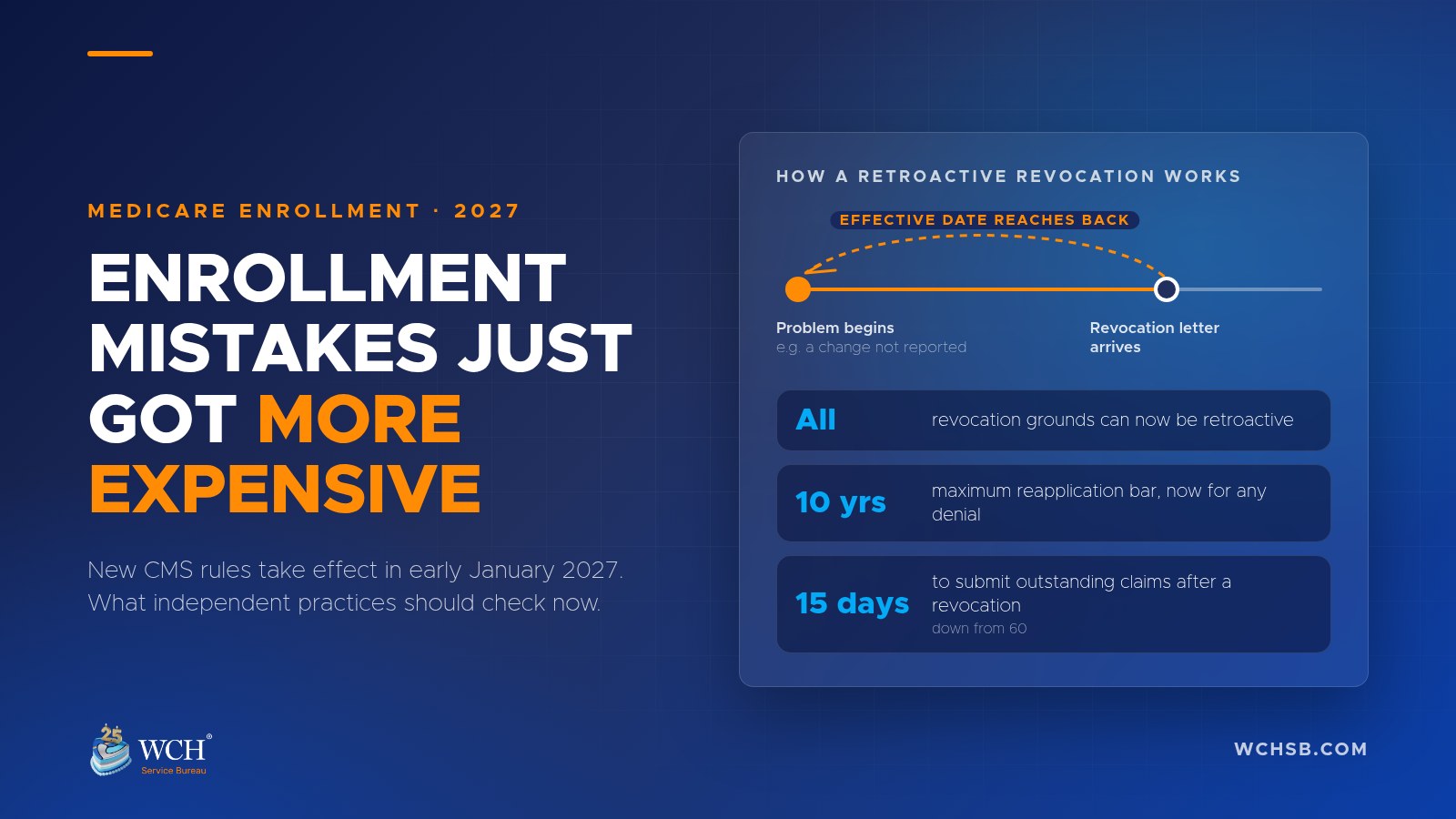
Until now, some revocations took effect 30 days after the notice was mailed, while others reached back to the date the problem started. CMS has finalized a policy that makes all revocation grounds retroactive. In practice, the effective date of a revocation can fall before the day you receive the letter. Claims Medicare paid after that date can then be recovered.
CMS puts a number on this. It estimates that the expanded retroactive revocations will move about $82 million a year from Medicare providers and suppliers back to the federal government.
2. A reapplication bar of up to 10 years, for any denial
CMS could already bar a provider from reapplying for up to 10 years, but only when an enrollment application was denied for false or misleading information. The final rule allows a reapplication bar regardless of the reason for the denial. This is a discretionary tool, not an automatic ban, but the ceiling now applies to every kind of denial.
3. “False or misleading” now covers more than the application
The existing rule on false or misleading information has been extended beyond the enrollment application itself. It now also reaches other Medicare enrollment forms and documentation. That can include the change-of-information updates a practice files after it is enrolled.
4. Your owners’ and managers’ problems become your problem
CMS could already deny or revoke enrollment when a provider has a suspended or revoked license in another state, or has been suspended or revoked from Medicaid or another federal health care program. Now the same applies when those actions involve the provider’s owners or managing employees.
5. More people may count as “managing employees”
The definition now lists clinical examples such as medical directors, clinical directors, department heads, supervising physicians, and nursing directors. If someone in that kind of role has operational or managerial control, they may need to be reported on your enrollment record.
6. Fifteen days, not sixty, to send outstanding claims after a revocation
The window to submit claims for services furnished before a revocation takes effect drops from 60 days to 15 calendar days from the date of the revocation letter. A letter that sits unopened for two weeks can now cost real money.
What CMS did not finalize: one proposal would have let the denial of one enrollment trigger revocation of a provider’s other Medicare enrollments. CMS dropped it, which matters most for groups that enroll several locations or entities.
Who it applies to, and when
The enrollment changes sit inside a home health rule, but CMS states that most of them apply to all provider types enrolled in Medicare. A few are narrower. The new rules on changes in majority ownership, for example, apply to hospices, home health agencies, and DMEPOS suppliers.
The enrollment provisions take effect 60 days after the rule was filed for public inspection, which places them in early January 2027. That leaves little time to make sure your records hold up.
Where practices usually slip
None of the new rules punish a practice for simply being small or busy. They raise the price of the ordinary gaps that build up in an enrollment record over time. These are the gaps that tend to build up quietly.
Changes that never get reported
Physicians, non-physician practitioners, and their group practices must report a change of ownership, an adverse legal action, or a change in practice location within 30 days. Everything else must be reported within 90 days. A new suite number, a partner who left, or a new billing address is easy to forget. Under a retroactive regime, that kind of lapse can cost far more than it used to.
Revalidation dates nobody is tracking
Most providers revalidate every five years, and DMEPOS suppliers every three. CMS posts due dates about seven months in advance and expects providers to watch for them, notice or not. When the person who handled the last revalidation has left the practice, the date often goes with them.
An outdated list of owners and managers
With managing employees now defined more broadly, the people listed in PECOS should match who actually runs the practice. That includes clinical leaders with real managerial control.
Mail that goes to the wrong place
Revocation and revalidation letters go to the addresses on file. With only 15 days to submit outstanding claims after a revocation, a correspondence address that points to a former office manager is a real risk.
This is the slow, detailed side of credentialing and payer enrollment, and it rarely gets attention until something breaks. It is also the work WCH has done for independent practices since 2001.
A short checklist before January
- 1.Open your PECOS records for every provider and every group enrollment. Compare each section with reality today: practice locations, suites, phone numbers, and correspondence and billing addresses.
- 2.List every change since your last update and when it happened. Anything past its 30-day or 90-day window should be reported now, not later.
- 3.Review owners, authorized and delegated officials, and managing employees. Check whether a medical director or supervising physician with managerial control belongs on the record.
- 4.Ask your owners and managers a direct question: has anyone had a license action in another state, or a Medicaid or federal program suspension? Under the new rules, their history can affect your enrollment.
- 5.Look up each provider in the Medicare Revalidation List and put every due date on a shared calendar, not in one person’s inbox.
- 6.Decide who opens Medicare enrollment mail and how fast. With a 15-day window after a revocation letter, that person needs a backup.
- 7.Keep copies of what you file and when. If your information is ever questioned, a clean paper trail is your best answer.
This article summarizes publicly available CMS materials for general information. It is not legal advice. For questions about a specific enrollment action, talk to your health care attorney.
Sources
- CMS-1844-F final rule, Federal Register
- CMS fact sheet: CY 2027 Home Health PPS Final Rule (CMS-1844-F)
- Hall Render: Medicare enrollment changes in the CY 2027 Home Health final rule
- AHCA/NCAL: What’s in the Physician Fee Schedule and Home Health final rules
- 42 CFR 424.516: reporting requirements
- CMS: Revalidations (Renewing Your Enrollment)