
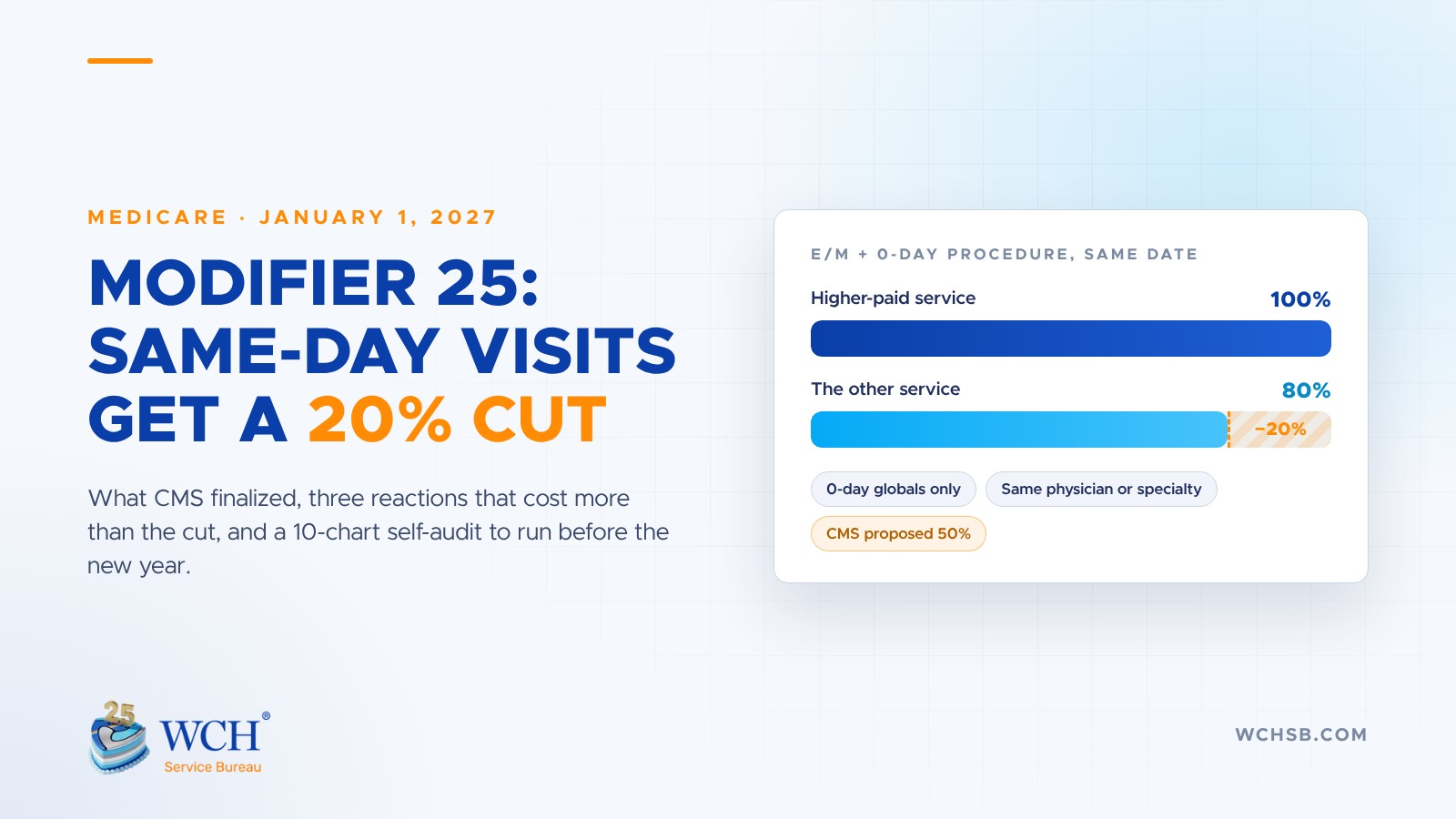
Starting January 1, 2027, Medicare will pay less when a patient gets an office visit and a minor procedure on the same day. The cut is 20% on one of the two services. The bigger financial risk is how a practice reacts: dropping the modifier, moving the procedure to another day, or raising the visit level to make up the gap. Each of those can cost more than the cut itself. Here is what changed, who it touches, and a 10-chart self-audit you can run before the new year.
What CMS finalized
The CY 2027 Physician Fee Schedule final rule changes how Medicare pays a separately identifiable office or outpatient E/M visit billed with modifier 25 on the same day as a procedure with a 0-day global period.
- The split: the higher-paid service is paid at 100%. The other service on that date is paid at 80%.
- Who: the same physician, or a practitioner of the same specialty in the same group, performing both services (Holland & Knight).
- Which visits: office and outpatient E/M codes 99202 to 99215 (ADS, citing MGMA).
- When: services on or after January 1, 2027.
- What CMS backed away from: the July proposal paid the second service at 50% and covered 0-, 10- and 90-day global procedures. The final rule is 20% and 0-day only.
The reduction falls on whichever service is valued lower, and that can be the visit or the procedure. To illustrate the arithmetic only: if the lower-paid service in a pair is allowed at $100, Medicare will allow $80 for it. This comes on top of a conversion factor cut to $32.63 for most clinicians, down 2.31%.
What did not change
Some summaries published this month have the details wrong. Check these before you retrain anyone.
- 10-day and 90-day globals are outside the reduction. A qualifying visit with a 10-day procedure still needs modifier 25, but it is paid as before.
- A colleague of a different specialty in your group is outside the rule.
- The documentation standard is the same. Modifier 25 still requires a significant, separately identifiable E/M service. The decision to perform a minor procedure is already included in the procedure's payment, and the two services do not need different diagnoses (NCCI Policy Manual, AAFP).
- It is a Medicare fee schedule rule. Medicare Advantage and commercial plans pay under their own contracts and policies.
Who feels it most
According to an AMA analysis reported by STAT, podiatrists, dermatologists and otolaryngologists are among the biggest losers. In practice, any clinic that does biopsies, injections, nail or skin procedures during a visit should run the numbers: that includes orthopedics, ophthalmology and primary care.
Congress may delay it. Plan as if it won't.
On November 12, the AMA and 61 healthcare organizations asked Congress to delay the modifier 25 reduction for one year, as part of a year-end package. The continuing resolution that funds the government expires December 11 (Becker's ASC). Until a law passes, January 1 is the date in the rule. If a delay does pass, the audit below still pays off. It is the same review that protects you in any modifier 25 audit.
Three reactions that cost more than 20%
- 1.Dropping modifier 25 to avoid the cut. If the visit was separately identifiable, not billing it gives up 80% of its value to save nothing. And a qualifying visit billed without the modifier is bundled into the procedure and goes unpaid.
- 2.Moving procedures to a second visit. The patient makes a second trip, may owe a second copay and waits longer for care. The practice gives up a schedule slot and takes on no-show risk. As a physician writing in Medical Economics notes, splitting visits also costs Medicare more overall. Scheduling should follow clinical judgment, not the fee schedule.
- 3.Raising E/M levels to make up the difference. This is where audits find money. In 2005, the HHS Office of Inspector General found that 35% of modifier 25 claims did not meet Medicare requirements, or $538 million in improper payments. The pattern has not gone away. In 2025, the OIG found that 44 of 100 sampled podiatrist E/M claims did not comply, and that documentation for 22 of 24 sampled E/M visits on the same day as eye injections did not support modifier 25. A 20% reduction on a correct claim is a cost. A repayment demand on unsupported claims is a much larger one.
Commercial payers have tried this before
Practices in New York and New Jersey have seen versions of this rule. From August 1, 2022, Horizon Blue Cross Blue Shield of New Jersey announced it would pay E/M services with modifier 25 at 50% when billed with 0-, 10- or 90-day procedures. Cigna announced an office-notes requirement for modifier 25 visits in 2022, delayed it, set a new date in 2023 and delayed it again. In 2026, Blue Cross Blue Shield of Michigan introduced its own 50% modifier 25 policy.
Medicare's rule now gives commercial payers a federal precedent to point to. Read the reimbursement policy sections of your top commercial and Medicare Advantage contracts. Note which payers adopt Medicare payment policies, and not just Medicare rates.
A 10-chart self-audit before January 1
- 1.Pull the pairs. List 90 days of claims where an E/M code from 99202 to 99215 with modifier 25 shares a date of service with a procedure, by rendering provider. Mark each procedure's global period (000, 010 or 090 in the Medicare fee schedule file). Only 000 pairs fall under the reduction.
- 2.Size the exposure. For each 000 pair, take 20% of the lower allowed amount and add them up by month. That is your Medicare-only number for 2027, before the conversion factor change.
- 3.Choose 10 charts. Start with your highest-volume provider and your most frequent procedure.
- 4.Read each note with four questions. Does it show a problem beyond the one the procedure treats, or work beyond the usual pre-procedure evaluation? Can the E/M documentation be separated from the procedure note? Does the E/M level rest on that separate work alone? Was the note copied forward from an earlier visit?
- 5.Score and act. Mark each chart supported, supported at a lower level, or not supported. Two or more unsupported charts out of 10 suggest a pattern. Fix the template and train providers before January, not after a records request.
- 6.Watch the first remittances. After January 1, confirm the 80% lands on the right line and only on 000 pairs. New payment logic brings new processing errors, and misapplied reductions can be appealed.
Where WCH fits
WCH Service Bureau has supported more than 12,700 providers and practices since 2001, across 22 states, with billing, coding and credentialing. Our coding team reviews same-day visit and procedure documentation as part of everyday claim work. If you want an outside set of eyes on those 10 charts, or on your whole modifier 25 pattern, before the new rule starts, tell us about your practice and we will suggest the right scope.
This article is general information about Medicare billing rules as published by November 26, 2026. It is not legal or coding advice. Payer policies and contracts vary, so check the current CMS rule and your contracts, or consult a qualified professional.
Sources
- CMS: CY 2027 Medicare Physician Fee Schedule final rule fact sheet
- Holland & Knight: CY 2027 Medicare Physician Fee Schedule final rule
- STAT: Medicare fee schedule change worries some specialists
- AMA: AMA, 61 healthcare organizations ask Congress for four Medicare reforms
- CMS: NCCI Policy Manual for Medicare Services, 2026, Chapter III
- HHS OIG: Use of Modifier 25 (OEI-07-03-00470)
- HHS OIG: Podiatrists' claims for E/M services (A-09-22-03012)
- HHS OIG: E/M services on the same day as eye injections (A-09-23-03014)